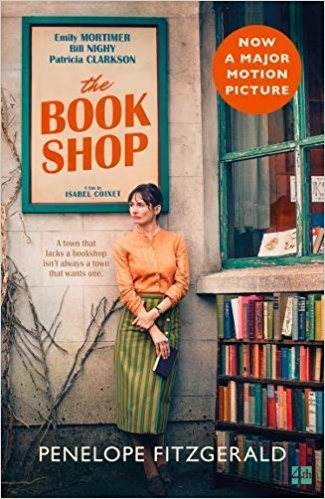
Hardborough becomes a battleground. Florence has tried to change the way things have always been done, and as a result, she has to take on not only the people who have made themselves important, but natural and even supernatural forces too. Her fate will strike a chord with anyone who knows that life has treated them with less than justice.
Comment: I brought this book by impulse from the library, only because it has the word "bookshop" on the title.
In 1959 Florence Green is a determined woman who wants to open a bookshop in a small town. However, it seemed most people do not care for a bookshop and there is even pressure to use the building for other things. While Florence thinks this doesn't concern her, it is a fact things don't always go well and perhaps she has to accept some things simply don't change...
I'm a little lost, to be honest, in what I should think of this novel. Thankfully, it was not a big book but the content didn't feel as easy to go through as that because, sadly to me, this was way too convoluted and confusing and I think I've missed most of what the point might have been.
The book was published in 1978 so there is that, I suppose, but I was mainly annoyed at how uninteresting the plot was because apart from a few scenes, not much appealed to me in the story. I was a little seduced by the books idea and bookshops in general being places I like because I like books, but this story was most definitely not about the love for books. I guess I was mislead by the movie (?) cover and the idea of books. Very disappointingly, there isn't that much talk about books here.
The central theme, from what I've gathered, is the vibe of small towns where things happen in a certain way and then someone new or different comes along and believes their ideas/vision would be a great novelty. I live in a small place and this, sometimes, can happen, but for the most part people are very close to their traditions and ways of behaving, so this part of the story was something I could kind of relate to, but the reasons why people in this book seem to dislike Florence feel ridiculous.
Well, reasons I assume were the one I've interpreted as such but I had some trouble understanding the plot. The author is clearly a talented writer but I can't tell if her style is trickier than what the story required or if she simply didn't present the information in a way I humbly could follow more easily... I now feel a little dumb reading some other reviews and thinking of certain details through those opinions. Does knowing this, however, make me want to appreciate the book better? Sadly, not really.
There are some interesting passages to think of, that is true, but the situations depicted just don't feel captivating to me. Florence isn't as layered as I imagined she would be, and even accepting the fact she is somewhat mysterious and that she is vibrant in a way the other characters she interacts with are not, I still think the vagueness of everything made this a hard story to appreciate as well as her role in it. I feel I didn't connect with what was happening and, in a way, this distance means the story simply failed to me.
Florence made an enemy, apparently, because she could not read between the lines when she decided to go ahead with the bookshop, and in where it was located. I mean, this is certainly an interesting study on petty little things in small places just piling up to childish behavior, but with all of Florence's optimism she still could not see the hints. The plot then develops in a one direction path, with some characters just popping up to add to the sense of confusion, and the end is, well, kind of predictable, since this is not meant to be a cute romance.
No comments:
Post a Comment