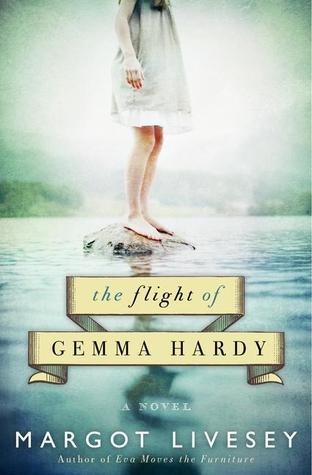
To Gemma's delight, the school goes bankrupt, and she takes a job as an au pair on the Orkney Islands. The remote Blackbird Hall belongs to Mr. Sinclair, a London businessman; his eight-year-old niece is Gemma's charge. Even before their first meeting, Gemma is, like everyone on the island, intrigued by Mr. Sinclair. Rich (by Gemma's standards), single, flying in from London when he pleases, Hugh Sinclair fills the house with life. An unlikely couple, the two are drawn to each other, but Gemma's biggest trial is about to begin: a journey of passion and betrayal, redemption and discovery, that will lead her to a life of which she's never dreamed.
Set in Scotland and Iceland in the 1950s and '60s, The Flight of Gemma Hardy--a captivating homage to Charlotte Brontë's Jane Eyre--is a sweeping saga that resurrects the timeless themes of the original but is destined to become a classic all its own.
Comment: I cannot remember why this book got on my radar. Probably a positive opinion somewhere and the link to the Jane Eyre inspiration/retelling.
Gemma Hardy is a young child when her uncle brings her from Iceland to Scotland after the death of her parents. However, her life isn't as idyllic anymore after her uncle also dies, and Gemma is taken to a school for girls, where she is no more than a servant. After years in the school and of adapting and surviving, Gemma is finally a young adult who accepts being a nanny in the Orkney islands to take care and tutor young Nell. Things are finally steady and Gemma feels this is a good opportunity to keep studying since she wants to go to university, and then she meets mr Sinclair, Nell's guardian...
Jane Eyre is one of my favorite books. I still remember how addictively devastating it was to read it when I was like 12 or 13 and that when it ended, I've cried buckets over the tragedies and the redemption Jane goes through. Thus, I was quite interested in seeing how the author would adapt this wonderful story into the 1960s in Scotland and make it work.
In general, I did like this book. There are enough similarities for me to enjoy the plot and expect certain situations but obvious differences too, so that the changes felt interesting on their own. Well, most of them, because while I liked the book and all those differences for the most part, I will have to say that my biggest disappointment was the way the author chose to separate Gemma and mr Sinclair at the key moment of the novel. In Jane Eyre, this happened for a foolproof reason; here, not really, in my opinion.
The book is divided into five parts, very clearly distinctive and related to Gemma's moments in life, and this does help to establish her character and fearless personality. Gemma is very likable and I always rooted for her but it is also true that, in spite of her having so much to deal with during her childhood and youth, she was always a bit too innocent. I mean this with the sense that she didn't seem to have gotten enough defense against what would be an obvious situation that could cause her harm.
Perhaps, part of why I got this feeling is because the author chose to have the story narrated in first person by Gemma. I liked her but I don't think this was the best option. If Gemma is this innocent throughout, her experiences are just too limited in her POV, and the nuances, the "read between the lines" inferences are simply lost, unless other characters have dialogue with her. I think this was a poor decision and brought the story down, in terms of emotion and character interactions.
Most situations Gemma faces are easily recognizable when comparing to Jane Eyre but, of course, since it is set at a different time period, there are obvious things that happen differently. I actually found it fun to think about this, to compare, but I can understand how it might not seem as interesting to other readers. Also, the fact this happens in the 1960s allows for some good changes but there are moments that simply cannot be done in similar fashion, such as the big conflict moment, which here was ridiculous to me, or how Gemma flies that big problem into her new circumstances. This part was very confusing and didn't really work for me.
The final part of the story does match what I remembered from the original source but having Gemma have Iceland roots and needing to seek information about them required some plot decisions that felt like one of the weakest points in the book. Gemma needs to travel to Iceland and the way she manages this was not easy to understand. I would have preferred her to have taken longer to manage this because the way she accomplishes this felt wrong, in terms of characterization. I suppose it was necessary to wrap things up but the whole Iceland setting seemed rushed plot wise.
I liked some of the 1960s references but there were times I completely forgot this too. So, I cannot say this was truly the best choice... although the author did research all the elements she used to make the story feel more realistic. In regards to the end of the book, I suppose I don't have to say what happened, but I confess I kind of expected a more detailed description of what Gemma's future would be. The author chose poetry, I'd say, and left things for the reader's consideration. Cute, but slightly annoying.
No comments:
Post a Comment