It has been an absolute pleasure to be part of the TBR Challenge, hosted by Wendy, the Superlibrarian.
One more year has passed and here is my summary of my choices.
It has been an absolute pleasure to be part of the TBR Challenge, hosted by Wendy, the Superlibrarian.
One more year has passed and here is my summary of my choices.
Lily is a dedicated painter who works as a barista to pay the bills. Her life in Chicago has bee everything she always wanted, although her best friend seems to be getting further apart and now she can't even pay the rent on time. While trying to find a solution she comes across several papers, including a forgotten divorce agreement she failed to send back, meaning she is still married to a Ben Hutchinson she met in Las Vegas. In an attempt to solve something in her life, she discovers Ben's location and travels to Wisconsin to deal with this situation in person, but the longer she stays in Minnow Bay, the more her plans change...
Back in April, I had read another book by this author and liked it enough to want to try something else by the author one day, although I wasn't planning on it happening so soon, but this story seemed to be a good fit for the November's topic. Lily is at a crossroads in her life, and a change of plans is the motivation she needs to improve herself and her life. I think the story was engaging and I wanted to know what would happen next, especially how would Lily learn about what wasn't going so well around her.
Lily is a painter and she has a sort of boyfriend who owns a gallery so, to her, things are great. But money wise life is tricky and Lily sometimes seems to be a little too distracted and naive, including on how she can cannot see her friendships aren't as solid as she imagined. At first, Lily seemed to be a bit too much of a scatterbrain to me and I wasn't too invested in her, but as the layers are being peeled, we can see she is actually quite alone, others don't take her into much consideration and she was being taken advantage of by those around her.
Her decision to look for Ben and deal with the marriage papers is the big change she needs to change everything else, but part of me was like, can you really forget you are married... still, in novels and movies, noting is impossible so I just went with it, and started picturing the romance, the usual situations in these types of stories. Surely, Lily would realize Ben was actually perfect for her, life in Wisconsin could offer her things Chicago couldn't and the new friendships would prove to be stronger than what she was leaving behind.
In a way, I think this is the traditional expectation of any romance or woman's fiction plot out there, and this book was marketed as such, but I should have guessed the author would give it her twist, as seen in my experience with her other book. Therefore, all the things I imagined kind of happen, but not as sweetly or as romantically as I wanted. This is to say, the story progresses in a predictable way, including other little things I didn't mention, but it's not in a syrupy or cutesy way. There are things that suggest a more dramatic vibe and I think that while this is an intriguing choice, it wasn't always one I enjoyed... Lily does change her life for the better but not without some "price" to pay.
I would say my favorite part of the story was how Lily got to learn things about herself and realize her new life could include all the things she liked, especially about who she is as an artist. This is extremely cliché of course, but it felt like the best executed part of the story. As things reach the end, I was glad for her, but some details ruined things a little, and without much need. I can only suppose this is the author's trademark, a HEA can exist only if including some kind of "but".
In this book, the first of a series, we meet Vaasa Kozar, a brave young woman, daughter of an emperor, whose evil brother sends to a marriage of convenience with a foreigner he wants to do business with for political gains. Vaasa knows there's more to this than what others assume, but after the marriage she flees, hoping to be left in peace to investigate the magical curse that seems to take her into darkness, but she is quickly found by her new husband. However, she is surprised to realize he doesn't intend to hurt her and, instead, helps her. As their relationship improves and her control of her magic too, life seems to become easier, but her brother still has an agenda against her newfound happiness...
I truly had no expectations about this book except, as always, that it would be a good story and that it would provide an entertaining reading. I don't read as much fantasy books nowadays as before, it's true, and the genre doesn't compel me as it did years ago. It also seems this book is labeled as a "romantasy" which, in fact, should appeal, because I have enjoyed fantasy and romance before, and still do. However, perhaps I can say the final effect wasn't one of great success for me, even though the several parts seemed competent and interesting.
The writing was fluid and easy but sometimes there were passages that felt confusing. I struggled to find motivation to keep reading. The elements were fine: a strong but wary heroine, an unknown but dependable hero, third person narration, a slow burn type of relationship, a common enemy to defeat, a need to join forces and magical abilities to be learned. However, the sum of all these things didn't captivate me and the fact I had some tasks in my life to distract me from reading several pages in a row didn't help either.
I think my biggest issue probably comes down to finding myself easily distracted while I had the time to read and that what I was reading was, mostly, a little boring. I failed to connect with the characters, to see their goals as essential and to grasp the urgency of what they had to accomplish. I can't fully explain it, since the same formula worked out for me when I read other similar books, but that it is.
The main characters had potential, of course, and their reasoning to do/say this or that seemed to have enough intention, but I don't think the author presented them in the best way and there wasn't enough chemistry. Vaasa was very self sufficient in some things and she needed to step back and accept help. I don't think this was done in a good sequence for the change to be believable. Reid seems like a good guy but he is described as ruthless.. I'd not choose this characterization for him, so to me he was a little monotone. I feel they weren't given enough scenes together to establish a believable link.
As the plot moves along, it had a lot of political maneuvers between several characters, but most characters felt very one dimensional. Still, I imagined things would lead into a battle of some kind and then the HEA. Well, not really so, for this story ends in a cliffhanger and it seems there is a continuation. I mean, I didn't check that this would be so, but why finish like this, a different end could have achieved a similar purpose. I don't feel interested enough to read the next book, though.
Comment: In this month of September, the theme for the TBR Challenge post is "friend squad", which I interpreted as a story where friendship or situations among friends were to take place. Since this story features a group of people who become friends and even start their own club of a shared love for puzzles and such, I thought no further.
The Fellowship of Puzzlemakers is a club founded by Pippa Allsbrook, and her goal was to create a group where the brightest minds would work together to make the best puzzles and other related challenges. They have lived together for years but now Pippa has died and she left a set of clues for Clayton, the baby they found abandoned on the steps of the club twenty-five years ago. Clayton knows he seems odd for those of his generation but he genuinely loves the club's members and his mother Pippa, so that is why he decides to follow her clues to learn about his birth parents and where he came from. On the way, he has to let go of habits and go on an adventure to London...and maybe abroad. But is Clayton ready to try new things and solve his own puzzle?
I had not heard of the author before seeing references to this book and it seems it is his debut. I was seduced by the blurb and the labels associated with it, mainly "fiction", "mystery" and "book club", which translate to me as something I might enjoy and that happened with other books. However, this story is actually a lot more fiction than any other label, and the story is divided into two times: the present with Clayton going on in his quest, and in the past, where we see how the fellowship was created and how the several members went on with their days.
I must confess this surprised me a lot, and it made for a slightly disappointing read. I say this because dividing the story so much between the two periods took out some urgency of the present situation, which I think should have had more attention. If the past period scenes were to be just three or four key chapters, let's say to explain or to give context to something important... but as it was, I felt the story drag a lot. It's funny because those chapters in the past did put in evidence the way the friendship of the fellowship members mattered so much to each individual, but I think this aspect did not have to be given so many pages for the message to come across.
Thus, when I think about the constant chapters in the past, I think about too much time spent on repetitive notions, even if the actual situations showed interesting tidbits. But this could have been achieved with a conversation or by other means. I suppose the idea was to set up Clayton's task in the present, but the alternated chapters kind of lost me this way; perhaps a few chapters in the past, and the rest of the novel in the present would have worked out better for me.
The present chapters, with Clayton searching for the clues to lead him to find out about his birth parents was a lot more engaging to me, but, of course, it was also very frustrating because we kept having to break through what he was doing for the next past chapter to come next. This means I didn't really feel an emotional connection with what was happening and while I appreciated the book's intention - Clayton doing the puzzle of the clues to learn the truth - the way it happened wasn't very stimulating.
I should say the book includes the graphic image of the same clues Clayton is given so that the reader can try the same challenge. I've found this to be cute but not especially rewarding. In fact, as the clues pile up and the truth becomes known, seeing how Clayton's parents behaved and why they left him for Pippa just seemed... troubling and the final reveal, when Clayton finally learns things, was definitely the emotional impact I imagined. It made many situations of the book seem weak and I've wondered why bother with so much information anyway.
Lord Julian Caldicott has returned from the war a changed man, persecuted by rumors about treason and mourning the death of his brother Harry. He decided he had to stay away from others, especially his family, to avoid scandal but his godmother lady Ophelia convinces him to help her attend a house party, which Julian thought he would leave as soon as possible. However, some old acquaintances and some trouble find him again among several people, many of whom don't hold him in high regard. As several little things pile up and Julian is more and more involved with the party and those around him, he starts noticing a disturbing pattern. It seems almost everyone would want him gone, but he can't help feeling his staying would hinder some nefarious plans. Will he resist the slurs and do his duty once more?
This is not my first experience with the author's work and of the books I've read so far, all exclusively romances, I've had a mostly positive reaction. However, the latest book I did read was my least favorite and it was with this recent memory I've started this one, which is labeled historical mystery. I must say that I had some expectations mostly related to the positive opinions of those who recommended this as being a good series and for the style I was used to from the other books by the author I had read, but in this story, the author's unique style and "voice" simply worked out to perfection.
The book is narrated by Lord Julian and his personality shines through, expertly added by mrs Burrowes writing tone, which is one of seriousness and resemblance to historical accuracy, at least when it comes to how the narration is presented. I always find her work very proper and correct and the atmosphere in her stories very authentic, of I can actually say this. Lord Julian is a wonderful character for he is a good and honest gentleman, with his vulnerable side and his quirks to make him imperfect yes, but still likable and someone we can root for.
At first, I thought he had returned from war and his "hard times" were related to his family disowning him because of the rumors and such but no. His problems are not financially related and I suppose this might not be the best way to suit the "do the hustle" theme, but Lord Julian does have a hard time, he might have money but he still needs to work his best to restore his reputation, to restore his self esteem and to battle the prejudice of others while the house party is ongoing. To me, now that I've read the book, the choice doesn't feel that out of place.
The plot is quite entertaining and ingenious. Something is going on with the house party attendees and from the start we are kind of led to believe it's all related to Lord Julian's presence and what people say of him and so on, but step by step we get to see the author's tactic, because many little things, which seem unrelated or unimportant, end up being part of a bigger scheme. I suppose fans of complex thrillers would find this silly and obvious, but it was still well done, in my humble not-obsessed-with-thrillers mind, and when some things finally make sense, the truth really becomes simple.
I also liked it that, while this isn't a romance, the romantic element is still here, and the hints of it, as well as the small things which help Lord Julian feel he is worthy and is on his road to think of himself as someone who was unfairly treated - I also now have my own theories about what happened to him when his brother died - so this means he will have an arc to redemption. His dealing with other characters, especially the ones who respect him, make me confident he will improve in all regards, even if that doesn't happen easily.
In this book, in the fictional university of Gloucester, Ralph Messenger is a prestigious teacher and one who enjoys the perks of his career, such as traveling and meeting as many women as he can, even though he is married. His wife apparently doesn't mind it as long as it doesn't affect their social life around the university. Then, for one semester only, Helen Reed is hired to replace another teacher in the literature department and Ralph is incredible attracted to her but she resists his advances. It seems nothing will change when a sudden discovery starts off a series of events none of them could predict...
By now I've read several of this author's books although way before I've started this blog and that's why most aren't mentioned here. My absolute favorite, of which I have so many wonderfully funny memories is Small World, which is part of a series about university teachers. How much I laughed and laughed reading that book...! Since David Lodge was also such a teacher, a lot of his commentary was purposely very analytical under all the funny plots.
Thus, this is why all these thoughts kept playing in my head when I read the expression "back in my day". I know that was not the intended meaning, but to me it was what came to mind and it did remind me of a time in which I was a student. Very convenient too, that the plot of the book is set on university/educational environment, somehow it all made sense to my personal interpretation.
The plot is very simple, in fact, basically Ralph is pursuing women, namely Helen, and many things contribute to delay or avoid the decision of them being together. While all this is ongoing, the author keeps adding many cultural, literary, mathematical, philosophical layers of commentary and this alone made the book for me. I can understand why many readers have found this element of the novel boring or as if it's just fillers for what seems to be a very poor plot, but to me this is the true beauty of the author's writing. A lot of what he learned and taught as a teacher comes across and I did like the musings shared about several subjects.
The plot is, indeed, too simple and to make it worse, the end is too open and I've felt no character really had to learn something from their adventures and options. On one hand, this happens because the author just can't avoid it to add some humor to his stories and we do get the feeling some things are too unlikely they border on fun, and then, the point of the story is not to present a good vs bad scenario, but one in which people often do things or assume things and reality might not be that straightforward.
I also think part of more negative opinions is related to the characters, namely Ralph. He is truly unpleasant and his adultery behavior makes him seem loathsome, which is a pity since he is quite clever and some of the more interesting passages come from his thoughts. He also feels he is entitled to this adultery and I really struggled to feel any kind of positive emotion towards him and applauded Helen for resisting him. Of course, some plot situations happen and we get to think of the characters through different perspectives but this is not a subject that changes, Ralph remains unfaithful.
As things progress, we discover some other issues have different POVs and what felt obvious was not so. I think the author was clever in organizing what he wanted to convey, although I'm not yet certain exactly what. Perhaps that we, humans, cannot limit our actions to simple ideas and everything can have more than one POV? That what is in our private thoughts if shared could reveal a different side of us that isn't so if we don't share them? I think any reader can have completely different conclusions.
This is the second book I try by the author. In 2019 I've read the author's debut, which was very well received, and I was one of those who liked it a lot. Since then, I've been "collecting" the author's work and had all four books published in the shelf and have been waiting for the paperback of the most recent release. I think it is safe to say I was more than hopeful in regards to my expectations about how much I'd like all the books by this author.
Well, six years after a good experience, I now feel very let down for I didn't really like this book that much. The story didn't fully grab me and only the fact there were interesting details here and there and my personal sense of nostalgia saved it from a negative grade. To make it worse, I kept thinking while I was reading, that the road trip premise is a great one but as if often happens to my personal taste, a lovers reunited trope in the mix didn't help at all and it didn't change my mind about my general lack of interest in such stories.
The story is told in two moments, the "now" and the "then" in relation to the status of Addy and Dylan's relationship. Thus, besides having them interact now with all that baggage and keeping up the interaction with three more characters, two of which also perfectly aware of what happened between them, we also had to go through their past history and what led to the break up. I'm really not a fan of these types of plots... the "then" drags the overall story too much and makes me think we are wasting time going through something that cannot be changed. I wouldn't have minded one or two flashbacks if they were necessary, but not this way. Better yet, don't use the lovers reunited, I bet a full new romance would have been better!
Addy and Dylan aren't bad characters but I never identified with them and I think it had to do with the way they are written. Addy has many qualities but her vulnerable side was often disguised (in my opinion) under other elements. Dylan reads as someone who is misunderstood by his father and who has no real course which makes him seem to be drifting and I didn't identify with him. In a way, they are only sort of likable by comparison, because the other characters are meant to be seen as almost stereotypical (Supportive but flighty Deb, buddy but mean Marcus, comedian but invisible Rodney) and the more I read, the more duty-like it felt.
Of course, in such a story, there is a metaphorical journey to be done at the same time they go on the physical one. Things get to the point where, closer to their destination, the truth finally comes out between these people and the feelings and situations they need to deal with are actually pertinent and I'd have liked to see them have a bigger role in the story, instead of just a tool for the climax.Thus, the way things were written, it seems there are just a few details to make it worth the read, to me. I think these final elements were more or less worth it, but... what a pity the story feels aimless for so long.
Comment: One more prompt for the TBR Challenge of this year, hosted by Wendy, the Superlibrarian. The theme for May is "older couple" and I struggled to find something which would not be part of a series. I know I have books I could insert in this category by Mary Balogh, for instance, but I want to read the books in the series in order, so... not yet. Therefore, this book was it.
This book had been recommended to me by a friend who gave it four stars around ten years ago and it features a couple with the ages of 36 and 40. Fairly, I would not say people with these ages are "old", at all, but in the world of fiction, especially historical romance, perhaps it might be easier to accept it. Plus, I had no other viable ideas in the TBR I could pick up easily.... I bet that from now on, books I could fit to this theme will come out of everywhere, though...
I had not tried this author's books either until now, so everything would be a surprise.. I was aware that a good part of this book would fit into the erotic category and this is something I no longer feel interested in, but I hoped that the combination of factors which led me to this book would prove to be good ones. However, I am sorry to say, I disliked this novel and the only reason I actually finished was because of the challenge and because I didn't want to look for a different choice.
The story itself is not complicated, Anne and Michael start seeing each other over a contract in which he will teach her about sexual gratification and she will pay him. I was not interested in this and I was not particularly taken by the characters so, I've skimmed most of the scenes in which they are having sex - thus, a lot- but the ones I read here and there showed what felt like a very clinical way of dealing with this. Perhaps realistic and "adult" in comparison with novels where this is overlooked or romanticized, but it did not help me to see the characters and the situation in a likable way.
I've also read the introduction note the author added in which she explains her reasons to write this novel and how frustrating it was that sexuality for women was so secretive and caused so many miscommunication and unfairness in relationships. I do applaud the idea and the need to write something that highlights an issue many might disregard but the execution to me wasn't a good one. I disliked the characters and the interactions between them all, not only between the main couple, but also the overall plot and the vibe of the novel, which means everything was a disappointment. Due to this, nothing was really interesting, not even the unusual themes the author wanted to address.
I won't go into details about the plot because, frankly, I don't feel like it. To summarize, Michael went through things that have affected his vision of life and relationships, he has suffered what I'd call severe abuse and mental trauma, and Anne was also subjected to an emotional situation which, of course, contributed to her current self image and why she now seeks this experience. Both their traumas, in different levels, are actually quite intriguing and I would not mind seeing them reach happiness after all that they suffered, but the erotic elements and the terrible things described here and there made for a story that just.... no and no.
There is also a villain, who is truly evil I'd say, and several secondary characters who do the villains' bidding. This means the main characters, especially Michael, are always anxious something bad will happen, and the reader feels the same, so... I was annoyed and angry most of the time that things got to this point. Then the villain does something to the heroine, and we learn more of what Michael went though as a child and... argh. No. This story is one to forget quickly.
Comment: I keep saying I don't remember why this or that book was added to my TBR and the same happens in regards to this book. No idea... but the blurb sounded great! Plus, the story was going to take place in a remote island somewhere around what could be the French Polynesia area! What a perfect choice for this month's TBR Challenge post, which is conveniently "location, location, location".
Prudence is an anthropology student in the US when the chance to travel to Oumatou, a remote island in the Pacific, comes her way which will help tremendously with her field work. Thankfully, she is friends with Manu, who is originally from that island, studying abroad on a scholarship, and after some doubts and eagerness, she finds herself going all the way there, with a brief stop in Hawaii to stay with her friend Susan. As soon as she arrives on the island, she is sad Manu doesn't stay around as much but he offers his mother's house for her to stay in and things go on well enough for a while. However, Prue is wary of some things and many inhabitants look at her strangely, which she thinks might have to do with her skin tone, but as she learns of legends and myths about the island and the smaller Mamao and Apiti surrounding it, she becomes restless. Is Prue truly safe in such a emote location?
I've seen this author - unfamiliar to me before trying this book - has an extensive background in anthropology and that is how she became inspired for her fictional work. I'd say the writing was not as smooth as we can see in other writers, perhaps who have dedicated themselves to fiction for longer, but dr Berwick used her knowledge precisely in the field of anthropology to invent a set of islands in the Pacific, so similar to real ones but different enough, to create several cultural aspects which aren't that surprising for us to believe could exist for real and set her story there.
The story has all the necessary ingredients to make this a compelling read. There were also times I thought back to those great adventure movies from the 80s and 90s mostly where the protagonists had to face weird set ups and still get ahead with unlikely odds. Prudence finds a way to travel to a remote island, even with misgivings, but she successfully reaches her destination. I think the details regarding this were made to seem a bit too easy when in real life it certainly cannot be, but I also had the feeling the author was more concerned about content than realistic steps.
I think the best achieved element was the atmosphere throughout the story. Prue herself says she feels uneasy, but the sensation that something isn't as right as it should can be felt from the beginning. This isn't horror, though, and the mystery reference in the labels for this book is very mild but the author has managed to develop a believable tone of edginess related to what Prue was seeing. The story is told from her POV, with four of five chapters closer to the end where we have her friend's Susan perspective in third person. I suppose it was the way for a few things to make sense in the end.
The plot is both simple and a little confusing because the author can't share everything right away, but there are details which start to make sense when we add up the information. Still, I imagined the whole story to be related to a specific event and how culture and prejudice and the evolution of communities might have affected such an isolated region but the truth was a little more... bizarre. When we finally understand what had propelled the whole thing, why Prue went through so many adventures and so much danger, when all is explained I was a little dumbfounded. I can see the author's idea but, really, it all ended up being a bit too weird.
The fascinating part was how the author used real anthropological facts and twisted them to create the mentality and culture of the people in these islands. Some things are so common among groups who live in countries/places we still consider to be far from "civilization" that it was easy to imagine the islands and the behaviors there. I was as interested in guessing the secrets as I was in seeing the dynamics between characters but this aspect was really very superficial. The author did enough, yes, but the intent was on how Prue was different to suit the plot.
I did love the islands' descriptions and it was very easy to go back to images of real islands in the Pacific for inspiration. Prue swam a lot in gorgeous locations! It made me think of what I'd do if something so extraordinary were to happen to me and in terms of location this story seemed way stronger than when it came to characterization. Sadly, most characters weren't really developed for a story which was quite focused on anthropology and how people vs groups might make a difference.
After centuries of existence, Ian is known for his rebellions and seductive manner, and he has collected enemies as well, such as Dagon. The demon wants to collect on Ian's soul but suddenly Veritas, a law enforcer, shows up making a deal with Ian, telling him they could join forces to defeat the demon. Ian was never one to turn his face on a challenge but surely Veritas has some secret agenda she isn't sharing... in the meantime, his charm and personality can certainly make up for most of his insubordination but will he be able to abide Verita's rules?
What time and memories do to us... I loved PNR back in the day and to an extend, I still do, but it is also true that it's not the genre that seduces me the most nowadays. Still, I was fond of the memories I got back when I started reading this book, which is a follow-up to events from the other books in the Night Huntress series. What fascination I had with this series.... Some beloved characters also have cameos and that was quite a treat, especially since I do think Ian, the protagonist, has the "rizz".
Actually, this is interesting because unlike what I assumed, the story is not told from Ian's POV. The Night Huntress books and all the spin offs are narrated in first person, usually a heroine, and the same happened here. The POV we have is that of Veritas, a law enforcer for the vampires and in this story she pairs up with Ian so they can trap and defeat a demon who has a deal with Ian, with the price of his soul. Veritas has a plan to kill Dagon, the demon, and she hopes that with Ian's help things will happen quicker, but of course it's not that easy.
As Veritas and Ian go along with their plans, they deal with some obstacles and they need to elude friends so that they don't get in danger, but while they go on with all this, they still start becoming reluctant friends and, at some point, more than friends. It's to be expected that they share personal things and a huge part of the novel, as it had happened with all the other books before, is focused on seeing them bond and slowly trusting one another the more things they find out about each other.
Reading this story brought back memories and some notions of what had happened in other books, but I'll have to say there were some more specific elements I no longer recalled. I think the author did a good enough job to create a story for a new reader, someone who might not have the information from past books, but not so much that a fan would be fully bored. Still, some things aren't as easy to remember... I must also say that Ian was still as charming but I must have let my impressions slide because I thought he would still be as cocky and rebellious as I remember him being in some books...here, he was a little less revolutionary.
To be fair, the last book I had read by the author was in 2017 and that certainly makes for some of my poor notions. I was still marveled by Ian in general, don't get me wrong, and I did like how he was seen by narrator Veritas, but even accepting this is a romance too, I was expecting more about Ian and not as much about them as a couple...after all, there are more books to come. We do learn things about them and their pasts, things we had not known from the other books, so that did pay off somehow.
In this historical romance, my first attempt at something by Sarah Maclean, we meet heroine Calpurnia, a young woman having her debut but she is fully aware she isn't a real beauty. Still, she has hopes and one random encounter with Gabriel, the marquess of Ralston allows them to exchange a few words and she is forever smitten with him. Ten years later, Callie is a wallflower on the shelf, as she tells herself, and she is tired of having the reputation of passive. Therefore, she writes down a list of tings she would like to do, like an adventure, and the very first thing is to be kissed. On a sudden impulse, she leaves her house and visits Ralston on his, something no lady should do, and she gets her kiss. For her, it's a great adventure, for him is a surprise but it just happens he needs her help to present his recently found sister to society.... is there a way for them to find happiness in each other despite their differences?
As a whole, this was quite a story and I liked the writing style enough to feel I might read more things by the author. I've seen that the author has recently published her first contemporary book and I think I remember seeing somewhere that some of her books weren't as traditionally historical as the ones in her early career and were more centered on "feminist heroines". I cannot prove this from experience but I should say that hearing certain things does impact one's opinion and I expected a certain type of story but this one was surprisingly sweet and very alike other historicals I've read by other authors.
The premise is set on Callie's need to do something for herself, a way to prove she isn't as passive and quiet as everyone assumes due to her looks and wallflower status. However, precisely because of this and her reserved personality, I struggled to easily accept she would be as daring as to look for Ralston on his house. If they had met at a social event or in the park or some other way that not her visiting him in his house, I think this adventure aspect would seem more natural. It certainly helps he knows her reputation and he asks for her help in exchange but their dynamics seemed stilted from the start.
Still, as the story moves along we learn that Callie is actually more daring than she seemed (but always with some understanding of her limits) and Ralston isn't the rake he is known to be by others. Their romance develops slowly, and the fun is in seeing how Ralston is more and more fascinated by Callie, even ignoring the supposed lack of looks for her taste for life and her way of seeing things, which gives him a different perspective in life. I wasn't especially touched by his behavior in the beginning and I think Callie wasn't always as shy as described, but I was interested in seeing how things would progress.
In part, I've felt this because at some point Ralston agrees on a wager with another man regarding Callie and I thought that surely when Callie learned of this that would prove to be quite the angst or drama, but I confess I've felt disappointed over the choices related to this subject. I also think the admittance of their own feelings, mostly Ralston's, was delayed so that some things were put into place. I can understand the tactic, of course, makes sense in any similar romance, but sometimes I thought it was also a little frustrating to wait for something more meaningful to happen.
In a way, this story did remind me of other books I had read with similar plots and in the same genre, so the real attraction was to see how the characters would evolve. Callie, as predictable, went from being a shy lady to someone who realizes her worth and that eventually matches how she behaves and deals with others. It helps her that being in love makes her more daring. Ralston, however, was harder to like despite his change of mind closer to the end, because I just can't love a hero who is afraid of commitment simply because of the behavior of a parent... isn't it obvious he is a different person? Still, psychologically speaking, this could be quite the theme but the author didn't go there.
Comment: It seems incredible but it's already mid January! I've signed up for another TBR Challenge, hosted by Wendy the SuperLibrarian, and that means it's time for the first post. The theme for this month is "New Year, whos dis?" and I've followed one of Wendy's suggestions of possible ways to go and picked a new author to me.
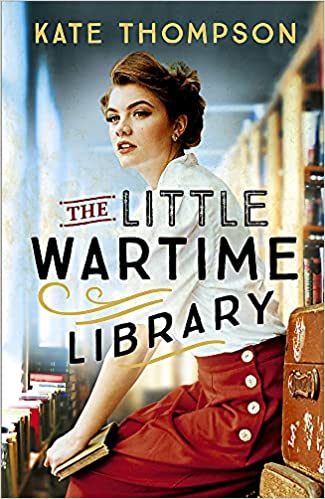
In this WWII related story, we meet Clare Button and Ruby Monroe, two librarians in London, who are keeping up with the Bethnal Green library, now in the tube station, since so many buildings were affected by the blitz. Clare has thought of this idea because in time of crises, people deserve to have something to look for and something to distract them from issues they cannot solve. Things seem to go smoothly and there are plenty of patrons who cherish the library as much as they do but, of course, there are always some who think differently. At a time where war and civilian rights are as much a concern as is if people will survive another day, can the librarians be a beacon of hope as they intended?
This story is my first attempt at the author's work, after another of her titles caught my attention. While investigating, this one also intrigued me and since it was more easily available to me, this is the one I've started with. It's a story set in London, between 1944 and 1945, with two more chapters - the first and the last - in contemporary times, specifically during the pandemic, told from a certain character's POV to contextualize.
The meaty part of the book, let's say, is set during the war and is focused on two characters, whose POV we alternate between, Clara and Ruby. They are both in their early 20s if I got that right, and they live in London during a time no one was really safe. Their story is mainly focused on their work as librarians and all that was necessary for them to do their work while dealing with a new boss, who aimed for tradition and rigidity in how things had to be done, while they both dealt with personal issues.
I would not say this was the most emotional story set during WWII I've read, but in part this might have happened because of the author's style. The story is fictional but based on real events - the author included fascinating notes at the end, which were, in reality, more interesting than the actual fictional story (I didn't even felt like I had to google anything) - and the author's energy and dedication to do her research justice does shine. Perhaps, in a way, a bit too much, because there were moments it felt the goal was more about the end result and not the real evolution of the characters...
I say this because while having the protagonists' POV makes many things more personal, it also means their views are limited and partial to what is happening. There were scenes or moments I wish we had a third person narrative instead. I did like that a lot of the story is closely linked to where they were, what was happening, and their librarian job. There is a lot on woman's rights (and the lack of) and what should be considered a "good library", what it should symbolize and the actual role a librarian had and still has to patrons and to those who need the library for more than just checking out books. I love libraries and I still visit my local one, despite being able to now afford more books than when I was a child of course, and several passages/situations were heartfelt.
Clara is a slightly more central character than Ruby, it felt and I liked her and what she symbolized for librarians and women. She is a sweet woman who feels her library is more than her duty and I was rooting for her while she faced the man who could jeopardize all her efforts. In terms of personal life, she is a young widow and her mother and mother in law seem to be antagonists to her, both in behavior and in views of the world. Clare finds someone she can love again, and a hint at romance was great, but... perhaps because it was not the goal, the romance felt a little...under done.
Ruby is an extrovert who loves her job and the apparent freedom given to women with the men away and the loosening up of the society "rules" when other issues are more urgent. Her family life is complicated and her mother is in an abusive relationship. Ruby also finds a man who will be there for her, thus another romance to consider. As I've said, the author put so much (good) use to the historical context that this element was really secondary execution wise. I mean, the romance of both Ruby and Clare matters to them, and is heavily linked with other important elements in the story but it's not quite there... some might argue that yes, it's not the main one, but if it's there anyway...
With a story set during WWII it's not a surprise there are some negative, sad, unfair, tragic situations included and of course the feelings associated with those scenes make for an emotional read. Still, to me, some things didn't really impact me the way I assume they are meant to because some passages seemed a bit too predictable for this type of story. I also didn't like some transitions between scenes, for instance when we are told about a certain characters' death, I think that in the attempt to match it as faithfully as possible to the real life event it was based on, made the writing detached. It might be only my impression, of course.