Showing posts with label Kazuo Ishiguro. Show all posts

Friday, September 28, 2018

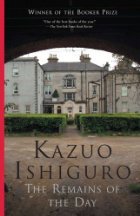
Kazuo Ishiguro - The Remains of the Day

The novel's narrator, Stevens, is a perfect English butler who tries to give his narrow existence form and meaning through the self-effacing, almost mystical practice of his profession. In a career that spans the second World War, Stevens is oblivious of the real life that goes on around him -- oblivious, for instance, of the fact that his aristocrat employer is a Nazi sympathizer. Still, there are even larger matters at stake in this heartbreaking, pitch-perfect novel -- namely, Stevens' own ability to allow some bit of life-affirming love into his tightly repressed existence.

Comment: This is the third book I read by Nobel Prize winner Kazuo Ishiguro and so far, my absolute favorite. I'm not actually trying to go through all his books but since I've seen them available at the library, why not use the opportunity to update on his work?
The previous books I've read weren't as amazing as I imagined but I finished them with different grading in mind. This one, however, ended up being my favorite.

This books can be described as a huge monologue presented by Stevens, the perfect butler of the old days when distinguished families of aristocrats used to have many servants in their houses. Stevens is a man of few words, and in this book he describes a car trip he has after years of service and all the contemplations the travel induces in him. Stevens is on his way to see another employee of the house where he has always worked in, Darlington Hall. The woman left the service to be married and after years of not seeing each other, Sevens wants to make certain she is well, considering a letter he received and where all pointed out for her marriage to not be as steady as he imagined...

There could be countless things to write about this book because each sentence has something to wonder about, to let the reader think. If one had the time, every detail would be a good enough conversation reason but to me, the fascination about this book is such that I don't have as many worthy words to write as the book itself is incredible. So, basically, I'll just write a little bit of why I liked it.

The writing style of this book isn't easy, the narrator Stevens does get lost a lot on his memories and it reads a bit like when we talk with someone, we also mention many things out of order. At first this felt complicated but with time I've come to enjoy immensely the "losing track" because that's when Stevens would add the most poignant sections of his memories. I can understand why some readers might not like this style, also not the time it takes for any useful information to be understood but for me it was a great way to be in tune with the narrators feelings and emotions and that certainly made it all worth it.

Everything we learn, in terms of plot, is through Stevens' eyes. This means we must infer several things, unless in a conversation with other characters we see a different POV and get other knowledge. This means Stevens is very proper, very controlled and never says something out of place, out line, out of proportion. Most of the details are so subtle we do need to read between the lines to better understand why some things are happening or would Stevens have described them that way. This is both slow and intriguing and I liked how much like a treasure it would be to discover something new in his words.

One such example is the relationship he had with miss Kenton, the housekeeper. They always had professional, cordial and objective conversations, even when they spent some time together at the end of the day discussing house matters.
Oh to describe perfectly the emotion of how subtle and powerful their feelings were just by the almost impersonal words they exchanged and later on to really read how Steven's heart was breaking after he heard something confirmed at last... I can't describe it, but those sentences were perfect, perfect, perfect!
Attention, this is no love story, but the way one could contain emotion while showing a professional demeanor and still let the reader "see" it... this section, closer to the end of the book, after pages and pages of subtle information being given just made it all worth to me.

There are some less than interesting details related to specific characters but most of the time, I was engrossed in the novel! To think that just by not being able to think ahead, the things we miss or don't realize we miss... but time doesn't go back. I liked the way this made me think about so many situations and how people can be so focused on one aspect of their lives, they disregard everything else (even if not so much in this society where we are bombarded with news and tales everywhere).
This is really literary in its presentation but what a gem to read.
Recommended.
Grade: 9/10

Tuesday, August 28, 2018

Kazuo Ishiguro - Never Let Me Go

Kazuo Ishiguro has been acclaimed in the Sunday Times for 'extending the possibilities of fiction. In Never Let Me Go he has fashioned another remarkable story - a story of love, loss and hidden truths - that takes its place among his finest work.
Kathy, Ruth and Tommy were pupils at Hailsham - an idyllic establishment situated deep in the English countryside. The children there were tenderly sheltered from the outside world, brought up to believe they were special, and that their personal welfare was crucial. But for what reason were they really there?
It is only years later that Kathy, now aged thirty-one, finally allows herself to yield to the pull of memory. What unfolds is the haunting story of how Kathy, Ruth and Tommy slowly come to face the truth about their seemingly happy childhoods - and about their futures.


Comment: When I saw this book available at my local library I decided to bring it with me because I remember reading somewhere it was a good one and since I had only read one book by the author I imagined it would be a good time to read another and compare how much I liked the style or if the other title I've read had been only an exception.

This is a disturbing story about an idyllic internal college for "special" children in England during a time we get to understand is a "possible" alternate world had things gone differently somehow. 
The story is told from the perspective of Kathy, the narrator and she tells us her story as a retrospective which means everything she says has already happened. However, despite the apparent simplicity of the tale, the truth is a lot more terrifying than one could imagine after all the pieces of the puzzle are put together.

This book is labeled in many different ways but to me I'd say this is fiction and that's it. 
However, another description is alternate reality/dystopian and that could fit it as well. 
I don't think I can write a lot about this without spoilers but the story is always a mystery to us until the end. There are obvious clues and hints here and there but I must say, after all the promising, after a sort of expectation the climax is a bit of a let down. I can understand the author's idea but... not the best execution and style.

Kathy is the narrator and she tells us things that have happened. This writing style has it's good details but overall the talking about something we hae no control of can be very frustrating and rather pointless. This tactic does allow us to get to know many details that unless the action was now on it, it would be too difficult to get with the same sad tone.
But Kathy is a very pragmatic character and her voice is more resigned than sad. I still felt sorry for her and those she knew from school but her tale could have been a lot more dramatic (in a good way).
The school hides a secret which isn't difficult to understand but after all the promising clues and crescendo of issues, does it reach apeak we wouldn't be able to imagine any other way?
No.
It's rather disappointing in that regard, what a great potential lost.

I can see why the author prefers to focus on the characters' personal lives and not the concept of the school itself since it obviously hides something shocking. It's supposed to make us even more horrified about what is going on. But, sincerely, all things considered, besides the idea of it, the scenes themselves are too hidden or unimportant to the plot on hand: I think the idea is too disturbing to contemplate but it would have been even harder to accept, the impact would have been perfection on out views if the characters had learned along with the reader.
The way things happen, I can't help thinking, if they knew about their fate and the school's secret so soon, why haven't they done differently? Why haven't they changed their lives somehow? How is it fate plays such a part but so avoidable considering some knowledge we get the students are intelligent? I can't understand this notion of just accepting their fate since this is still a contemporary story and they are not prisoners their whole lives.

This is one of those books that only reading can we have an opinion and there is a lot to debate but in trying to be subtle and lyric at times, I think the author let go of too much potential and that is quite a pity on what could have been outstanding. For me, it was good but not great but I'll probably will read more by the author.
Grade: 7/10

Thursday, November 16, 2017

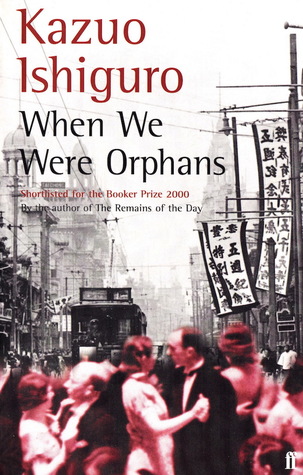
Kazuo Ishiguro - When We Were Orphans

England, 1930s. Christopher Banks has become the country's most celebrated detective, his cases the talk of London society. Yet one unsolved crime has always haunted him; the mysterious disappearance of his parents, in Old Shanghai, when he was a small boy. Now, as the world lurches towards total war, Banks realises the time has come for him to return to the city of his childhood and at last solve the mystery - that only by his doing so will civilisation be saved from the approaching catastrophe.
Moving between London and Shanghai of the inter-war years, When We Were Orphans is a story of memory, intrigue and the need to return; of a childhood vision of the world surviving deep into adulthood, indelibly shaping and distorting a person's life.


Comment: I was at my local library and this book caught my eye. I knew the author is this year's Nobel Prize winner but while I didn't run to get his books immediately, I still remembered and considering this book wasn't too big, I thought it would be a good way to know his work and see if I could also think he deserved the prize.

This book is focused on Christopher Banks, an english man who has lived his childhood in Shanghai and now has a career as a detective, simply because he has had this golden image of detectives in China, looking for his missing parents.Although years have passed, the mystery remains until Christopher finally decided it's time for him to return and use his currently famous skills to uncover what happened so many years ago. But will Christopher like what he finds?

Reading this book was quite an experience. It's not a big book but I confess I wasn't always able to easily focus on what I was doing and often I was easily distracted. Still, it was very interesting to follow the mystery of the disappearance of Christopher's parents, especially because the outcome wasn't what I expected, even if I suspected something on those general lines.

Many readers have commented one of the biggest struggles is the lack of connection with the narrator, Christopher, because he is seen as just a character looking for a goal at the expanse of other details, and we never get to really know him and his thoughts on mundane things, such as how he solves the mysteries in his work. However, I didn't really mind not having more of Christopher's ideas as a grown up. The real beauty in his character is how he has manage to retain so many memories of his past and this clouds him today. One could say this isn't precisely a matter of beauty, but the writing has its appeal in this: we are carried along with Christopher to what he sees and wants to know and not as much the outside details that could have let us engage with his personality more, but...

What really made me like this book was Christopher's detailed images of his past. It's a known fact when we grow old, when we grow up, many of the things that used to make us us are gone, are dismissed, are put aside as fancy childhood phases. We remember this and that but it's gone, it's forever in the past and we can't live it again. Christopher has moved from Shanghai to England but his home will always be Shanghai in a way. How incredibly sad this can be, this need to hold on to things that used to be so fierce and engraved in one's mind but then they disappear. Christopher just focused on this, so he could not only regain his childhood feelings but the way he saw himself at that time. Finding his parents was like finally remembering there was a missed light to turn off after leaving the house and Christopher wants closure but that's not easy to accomplish.

The secondary situations that are part of this book, even the characters, all that almost seems to lack importance but we can see it's just a means for Christopher to remember and to let us know why his demand can't be over until he finds his parents.
I won't reveal the end, the twist but I shed one or two tears when Christopher finds the truth about everything that happened and although I can say it was rather melodramatic, it was interesting to squeeze it all to one basic sentence: our memories can be deceiving, we only remember things partially but the love of a mother can be...everything, forever.

Since I could overlook pretty much everything but Christopher and his wish to find a truth for what his memories meant and still do, this book was a good one for me. But I can understand many readers there are many flaws overall to make it a success. But well, each person sees things differently... I do agree the last 40 pages or something were somehow too weird but... in general, I can say I liked it.
Grade: 7/10