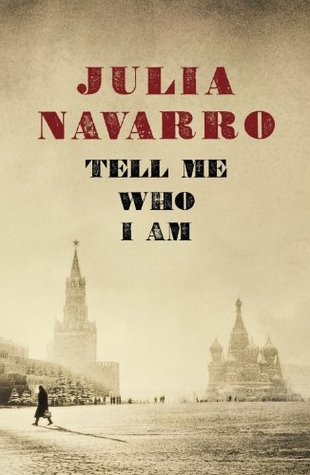
 Tell Me Who I Am
surprises and enchants with a captivating and heartrending story. This
is a novel about memory and identity with an exceptionally well-drawn
and unforgettable literary character: a woman who throughout her
extraordinary life was able to achieve the highly difficult feat of
knowing herself. A victim of her mistakes, aware of her guilt,
frightened by her traumas, she is above all an anti-heroine, a
flesh-and-blood woman who always acts according to her principles,
facing up to every challenge and making errors for which she will never
fully pay. A woman who decided that she couldn't be neutral in this
life.
Tell Me Who I Am
surprises and enchants with a captivating and heartrending story. This
is a novel about memory and identity with an exceptionally well-drawn
and unforgettable literary character: a woman who throughout her
extraordinary life was able to achieve the highly difficult feat of
knowing herself. A victim of her mistakes, aware of her guilt,
frightened by her traumas, she is above all an anti-heroine, a
flesh-and-blood woman who always acts according to her principles,
facing up to every challenge and making errors for which she will never
fully pay. A woman who decided that she couldn't be neutral in this
life.Navarro's most personal novel surprises for its melodrama and the raw emotions transmitted by many of its stories. It is filled with pure adventure, introspection and political chronicle. From the tumultuous years of the Second Spanish Republic to the fall of the Berlin Wall, including World War II and the Cold War, these pages are packed with intrigue, emotion, politics, espionage, love, betrayal and settings like Madrid, Barcelona, Paris, Buenos Aires, Mexico, Moscow, London, Berlin and Warsaw with brief stopovers in The Basque Country, Cairo, Athens, Lisbon and New York.
Comment: After a lengthy book which was Anna Karenina here I went again with reading a big book and this 1083 pages story was my first pick of March. Again, this was a book I've read in Portuguese and it was lent to me by the same person who has lent some others in the past.
In this book, we sort of follow the story of the 20th century through the investigation of Guillermo, a journalist who's had bad experiences because he feels he is honest and doesn't want to be on any political side. To help his finances, his wealthy aunt asks him to investigate her grandmother, someone very shady in the family. In order to do that, Guillermo embarks on trips all over the world and what he discovers starts to become more than a job, it's like getting to know a woman no one would ever think could have achieved what she did. But why can't he simply investigate, why does he need to follow her steps one at a time until the end?
This is not my first book by the author. I've tried one of her historical mysteries and was not impressed, especially after having it to read for years.
There are more or less 6 years between the publication of that other book and this one and, content aside, I think the writing itself has improved to the extent that this story felt more fluid than the other. Or, because I've read translations and not the originals, it might be just a random detail.
In this book, the story is told by several characters the main protagonist, Guillermo, is interviewing so he can collect information about his great grandmother, someone not talked about within the family. In his investigation, Guillermo finds out Amelia, that was her name, had sisters and a family that was never part of Guillermo's. After finding out those links, Guillermo embarks on a trip through a century filled with revolutions and wars and, somehow, his great grandmother has been in the middle of it all.
The story is basically told in the first person, through witnesses that lived with, or around or knew Amelia during her youth. Some sections are very difficult to read because it involves what we know were some of the worst moments of the human species in this planet. Guillermo stops being the enter of the action and Amelia becomes it, through the voices of others. The book is divided into 6 major parts, all focusing on a specific stage of Amelia's life and actions. I liked the story, I confess some parts were a lot more intriguing than others, but what really makes this feel heavier in terms of emotions is the notion that all those things - especially the bad ones - did happen for real and we can imagine how many people did suffer and were affected by what was happening around the world.
Amelia, the real protagonist is describes as many things and she is considered a lot more than that but I have to admit it bothered me a bit how she got herself in danger so many times. For someone with her experience, at some point, she should have been more careful. But of course this is the point, sometimes we just loose ourselves in what we do and we sort of loose track of why. i think this was it with Amelia, she started her whole life adventure because she fell in love and she exchanged everything for that and what came after. But some actions just don't make sense...
At the same time, what can we say? In the sight of suffering and injustice, if we can do something, is it that easy to not be involved if our spirit is on that page? I'm talking about a period where people lived things in a way the current generations more or less don't, where information wasn't available at any moment and we had to wait to see what would happen... in terms of inserting the historical facts with fiction, I think this worked out pretty well.
I think this huge book is a sort of summary of the big conflicts in the 20th century, obviously focused on the Spanish civil war. But more than the fictional stuff, it's the real facts that make this come alive. It's so sad to think so many things could and should have been avoided but... now it's a lesson to be learned and sadly most people in power don't see it that way.
In terms of fiction, it was more or less cleverly done. The end was a bit abrupt and we don't really have closure on every little aspect but I suppose the impact feels bigger because of that as well. It was a surprise alright, the reason behind all the investigation.
Despite everything, it was entertaining to read this, that was for sure.
Grade: 8/10
