Showing posts with label Anthony Doerr. Show all posts

Tuesday, February 28, 2023

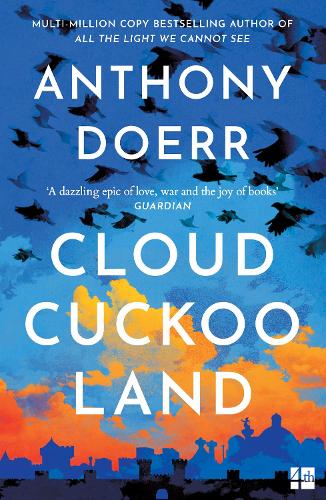
Anthony Doerr - Cloud Cuckoo Land

When everything is lost, it’s our stories that survive.
How do we weather the end of things? Cloud Cuckoo Land brings together an unforgettable cast of dreamers and outsiders from past, present and future to offer a vision of survival against all odds.
Constantinople, 1453:
An orphaned seamstress and a cursed boy with a love for animals risk everything on opposite sides of a city wall to protect the people they love.
Idaho, 2020:
An impoverished, idealistic kid seeks revenge on a world that’s crumbling around him. Can he go through with it when a gentle old man stands between him and his plans?
Unknown, Sometime in the Future:
With her tiny community in peril, Konstance is the last hope for the human race. To find a way forward, she must look to the oldest stories of all for guidance.
Bound together by a single ancient text, these tales interweave to form a tapestry of solace and resilience and a celebration of storytelling itself. Like its predecessor All the Light We Cannot See, Anthony Doerr’s new novel is a tale of hope and of profound human connection.

Comment: This was probably one of the books from 2021 people liked the most. At the time, I was able to ignore the hype easily, but I did give in to it when I saw a paperback edition at a store and eventually agreed with a friend for us to buddy read it. With such good ratings in several websites, I confess I expected more greatness...

In this book we follow the lives of several characters, in several moments throughout time, as they go on about their lives and must deal with challenges and obstacles while seeking for something. Somehow, there is a piece of literature that bonds them all, the ancient text an author dedicated to his sister.  How these characters are linked because of the text is what drives the main plot but in each main character there is something to look for and something to be done... but will everyone manage to make the right choices when it comes to their own lives? And how will that affect the lives of the others in their own time?

All the Light We Cannot See put this author on the map and it has certainly raised the expectations on whatever work he might produce because that was a very enjoyable and successful book. I include myself in sharing these accolades for that book. Of course, books are worthy on their own and not because we should simply compare them with one another, but I must say I was hoping for something as emotional and profound as the other book was. I think some parts of this one felt like that but as a whole... not so much.

To start with, I've felt this is a very confusing story line. The reader has to divide focus and attention into several time lines and characters. At the base we have what is said on the blurb: action in the 15th century Constantinople, Idaho 2020 and somewhere in the 2100s in the future. Then, we also have scenes regarding other moments in the life of some of the main characters, not only in these main times. I should add the action goes back and forth from chapter to chapter, making this a rather dizzy experience and, as others have said, making it feel as if we can't truly connect with what is going on.

The main story line is attached to the ancient text characters are studying or working with and which connects their lives throughout time. I think this idea is sometimes lost because we have a lot of detail on every main character and it's not always pertinent to the need to understand this ancient text. As far as an "excuse" or"starting point" goes, I confess I was not sold on the importance or even beauty of the text. Of all the details and descriptions, I must agree with readers who said it takes too long to explain an idea or a setting before it even becomes integral to the story.

I can only imagine the narrative and writing are meant to be appealing and the author wanted to use suggestive prose and create a rich setting, but to me the effect was the opposite, I've felt bored plenty of times until around the 55% mark. Added to the confusing elements, many things are told in such a way we have to assume they are important and at the end, it turns out that some of those many pages could have been summarized without losing impact. I wouldn't say there's more "filler" pages than necessary ones, but a lot of what is shared isn't always that special for the endgame.

The main characters are interesting on their own, I think. I liked reading some of the sections about Zeno, and I liked Konstance as a character. Konstance is a young girl of the future, whose sphere of action happens in a space ship. Zeno is an old man at a library in 2020 but we also have glimpses of his youth as a military man in Korea. What they have in common is actually quite flimsy. to be honest, so the expectation that there's this complex and amazing link between everything in the universe is kind of lost or nonexistent, which ended up being disappointing. The characters in Constantinople only seemed to matter a bit more when the story is reaching the end, so... all that setting up felt wasted.

Zeno has had some intense experiences in life and I would have liked to have more focus on his life instead of just glimpses for the supposed purpose of this novel. Konstance is a fascinating character and probably is on the most challenging setting of them all, and tension is built with each new chapter from her POV, which made me assume something big would happen related to this but when the final page is turned on her POV, despite the surprising situation she is actually in, I must say I thought the author would expand a lot more, we don't have that much information except our personal assumptions.
Basically, there's a lot of ideas, a lot of human behaviors to explore and think of, which is good but then, again, perhaps all those pages were a bit too much. I would have liked the story to have more definition, more specific ideas developed instead of a lot of secondary setting up. The actual plot, underneath all the extras, wasn't too bad, and I was curious to know why those characters were made to look as if they mattered a lot, but the end result wasn't as great to me. I feel as if the individual characters weren't too bad, but as a whole, the novel - attempted to work out in such a long plot - wasn't as successful.
Grade: 6/10

Tuesday, October 10, 2017

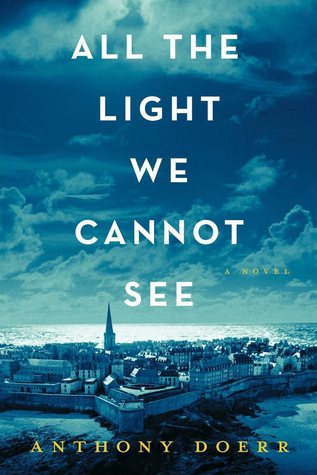
Anthony Doerr - All The Light We Cannot See

From the highly acclaimed, multiple award-winning Anthony Doerr, the beautiful, stunningly ambitious instant New York Times bestseller about a blind French girl and a German boy whose paths collide in occupied France as both try to survive the devastation of World War II.
Marie-Laure lives with her father in Paris near the Museum of Natural History, where he works as the master of its thousands of locks. When she is six, Marie-Laure goes blind and her father builds a perfect miniature of their neighborhood so she can memorize it by touch and navigate her way home. When she is twelve, the Nazis occupy Paris and father and daughter flee to the walled citadel of Saint-Malo, where Marie-Laure’s reclusive great-uncle lives in a tall house by the sea. With them they carry what might be the museum’s most valuable and dangerous jewel.
In a mining town in Germany, the orphan Werner grows up with his younger sister, enchanted by a crude radio they find. Werner becomes an expert at building and fixing these crucial new instruments, a talent that wins him a place at a brutal academy for Hitler Youth, then a special assignment to track the resistance. More and more aware of the human cost of his intelligence, Werner travels through the heart of the war and, finally, into Saint-Malo, where his story and Marie-Laure’s converge.


Comment: I had this book in my TBR list but I confess I was not thinking of reading it in the near future but I was recently at my local library and there it was so...I guess it just felt like a good moment to pick it and since I had a deadline of course I didn't waste much time reading it.

This book is very famous, it has won several awards and prizes and many people have read it. Basically, the plot revolves about World War II and how people were affected by it, namely two young ones, from different parts of the world but whose lives cross at one single moment and that changes them both.
Marie-Laure is a french girl whose father needs to leave Paris when the Germans get close and Werner is a young orphan boy that has a golden opportunity to change his life but can he put all his care and wishes behind?

I suppose most readers of this book have amazing things to say about its content and how powerful it can be. I also assume most books centered in or about the themes connected with WWII would be so, considering what we know about the subject. I also think this was quite emotional but it didn't touch me as deeply as other books. To me, what makes this book so amazing is the way we are told about certain things and the obvious amount of detail the author had to analyze to end up with a very fluid story.

In terms of writing, this was a good book for me. I didn't know the author's work but the approach used here was a positive one, I'd say, especially because the graphic layout of the written content are was appealing to readers: having small chapters and switching between Werner and Marie-Laure's perspectives on their lives was a good way to make this book easy to read and not simply a boring and extensive text.

The content has its moments. We have three main situations happening, the character's singular lives, the search for a special valuable rock and the historical context we always need to bar in mind.
All aspects combine themselves at the end and I think until the last three chapters or so, everything felt useful for the plot and the emotional aspect. The final chapters show some situations into the future, after the major storyline is concluded but for me this was probably the weakest part of the story, I just didn't read it from such an emotional POV as I think it could have been seen.

Marie-Laure is quite the heroine through her teenage years, while Europe is at war. I liked her a lot as a character, she did so many hard choices but she is easy to like and to root for.
For me, the best thing about this book was Werner's character. I felt he was the one who had more to change in his life, he learned some very difficult lessons and through him we could see a side that most historians and even novelists don't usually touch when working on WWII: the side of the common Germans who actually had way to fight what was happening but were immediately and easily labeled as something they abhorred themselves. It's always easier to talk when we are not the ones living it.

The writing itself is very easy to describe, I think most readers could easily imagine the descriptions used, especially when it comes to the more subjective details and metaphors. There's beauty in almost everything if only we look for it. The author also included lots of technical stuff which I can't really talk about.
The characters are all very special, even the "bad ones" have something in them one could exploit emotionally. But yes, it's easy to pick a side. Some details are truly powerful and from a a reader's POV, this can be seen as entertaining and emotional story. For me, it just could have been more and the end different somehow.
Grade: 8/10