Showing posts with label Evie Dunmore. Show all posts

Thursday, January 25, 2024

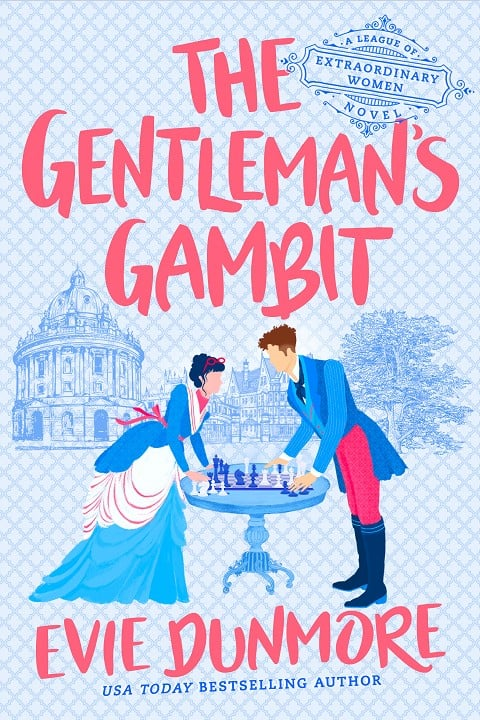
Evie Dunmore - The Gentleman's Gambit

Bookish suffragist Catriona Campbell is busy: An ailing estate, academic writer's block, a tense time for England's women's rights campaign--the last thing she needs is to be stuck playing host to her father's distractingly attractive young colleague.
Deeply introverted Catriona lives for her work at Oxford and her fight for women's suffrage. She dreams of romance, too, but since all her attempts at love have ended badly, she now keeps her desires firmly locked inside her head--until she climbs out of a Scottish loch after a good swim and finds herself rather exposed to her new colleague.
Elias Khoury has wheedled his way into Professor Campbell's circle under false pretenses: he did not come to Oxford to classify ancient artefacts, he is determined to take them back to his homeland in the Middle East. Winning Catriona's favor could be the key to his success. Unfortunately, seducing the coolly intense lady scholar quickly becomes a mission in itself and his well-laid plans are in danger of derailing...
Forced into close proximity in Oxford's hallowed halls, two very different people have to face the fact that they might just be a perfect match. Soon, a risky new game begins that asks Catriona one more time to put her heart and wildest dreams at stake.

Comment: This is the fourth installment in the League of Extraordinary Women series, whose first books I read in the beginning of 2022 Now, two years later, the quartet is finally finished and I must say that while this was a good addition to the series, it wasn't as fascinating to me as the first book, which I loved. Nevertheless, I like this feeling of having finished another series.

Catriona is the last heroine of the group of suffragist friends but she isn't certain she would be as happy, as they are now, if she were to marry. She likes her solitude moments and she already has a lot to do, between her academic work and her suffragist campaigns, which means she isn't interested in romance. However, while at her family's estate in Scotland, she is swimming naked and as she leaves she sees a man looking at her. Although flustred, she goeas home to find the stranger again, as a guest of her father.
Elias Khoury knows his different culture and origin doesn't make it easy to accomplish his goal, but being sponsored by Wester Ross is half way to find the artifacts stolen from his country, which he plans to recover in any way possible. He can't help being interested in his daughter Catriona, though, not only because she intrigues him, but because she is someone he could love... but between duty and love, what will prevail between these two?

As I expected, this was a good follow-up to the previous stories, featuring this group of rebel women who want rights for women to be approved. The story, as a whole, made sense and I liked reading it, but in my personal experience, the time between the release of the third book and this one (why is now irrelevant) kind of cooled down my dedication, and I feel the urgency to read just wasn't there, as it had been when I was reading the other books.

That aside, I've also seen some negative reviews and even though I have not read them fully, just seeing the grades in some sites did influence me. Therefore, I feel positively surprised I still enjoyed this book, but I'd put it at the same level with the third, which I liked too, but the second was so much better, and the first did win me over. I can only infer if there were more books,perhaps they would gradually become less captivating...

Well, Catriona is a heroine I could sympathize with because of her being rather introverted. I found myself nodding at some of her thoughts, and I think I'd behave in a similar way in regards to her views on being around large groups of people, for instance. I think she is a quiet but interesting person and some of her reckless choices here and there did seem to be caused by emotions which one can relate to. In terms of the romance, I can understand why some readers found her to be too slow, too cautious, but I kind of liked this side of her, since it matched her personality.

Elias Khoury is a more complicated character to read, he did seem more aloof and when he was describing his ideas or when we could know his thoughts, even the ones about love and a possible relationship with Catriona, made him look not as easily approachable. I suppose the different origin (he is from Beirut) and culture and way of living in relation to the British and Scottish were ways to place barriers between them and why they couldn't simply give in to their feelings, but... the romance to me was good enough I'd say, but along with the plot moves, not as devastatingly compelling as the romance of the first book was.

The plot isn't difficult, basically Elias wants to recover artifacts which were taken without consent, and a big part of the conflicts, of the conversations between several characters is somehow related to this. Clearly, the author had an intention, which one can see as a good one, but the execution can feel different to different readers. There's also the issue of how they could be a couple, taking culture and geography into consideration. In this aspect, I think the solution was one we can accept but I can't really say if I feel it was the best one...

In general, I liked reading the book and I think it wasn't as bad as some people say, but yes, it didn't amaze as much as the others. The HEA between Elias and Catriona also had some little details that perhaps could have been done differently... then, there's the epilogue, several years in the future, with the main characters of the series at an older age. I mean, it was obvious why (especially thinking about the moment the author used to set the final scene) but I'll be honest and say I'd have preferred it to not exist. I think a simpler epilogue, or a slightly different ending scene without epilogue at all, would have been a better choice, in my opinion.
Grade: 7/10

Thursday, March 24, 2022

Evie Dunmore - Portrait of a Scotsman

London banking heiress Hattie Greenfield wanted "just" three things in life:
1. Acclaim as an artist.
2. A noble cause.
3. Marriage to a young lord who puts the gentle in gentleman.
Why then does this Oxford scholar find herself at the altar with the darkly attractive financier Lucian Blackstone, whose murky past and ruthless business practices strike fear in the hearts of Britain's peerage? Trust Hattie to take an invigorating little adventure too far. Now she's stuck with a churlish Scot who just might be the end of her ambitions....
When the daughter of his business rival all but falls into his lap, Lucian sees opportunity. As a self-made man, he has vast wealth but holds little power, and Hattie might be the key to finally setting long-harbored political plans in motion. Driven by an old revenge, he has no room for his new wife's apprehensions or romantic notions, bewitching as he finds her.
But a sudden journey to Scotland paints everything in a different light. Hattie slowly sees the real Lucian and realizes she could win everything—as long as she is prepared to lose her heart.
Going toe-to-toe with a brooding Scotsman is rather bold for a respectable suffragist, but when he happens to be one's unexpected husband, what else is an unwilling bride to do?

Comment: This is the third installment in the League of Extraordinary Women series by Evie Dunmore. Having enjoyed the previous books, of course I would want to keep up with the series.

In this third novel we follow heroine Hattie, from the group of women we've come to know since book #1. Hattie is a romantic, wants a fairy tale romance and she has joined the suffragists for companionship and to feel she is part of a cause, not because she spends her days dealing with the demands of a woman without choices. However, during one of her escapes to do what she likes, she gets herself in a complicated situation, which only gets worse when she is seen, days later, leaning in to kiss Lucien Blackstone, a man considered ruthless and with murky origins. 
Lucien actually planned the scene a little for he wants to marry Hattie because of the influence of her father. However, she isn't happy to know their being caught was staged by him and they are off to a rocky start. Lucien isn't actually as bad as others say although his plans for revenge are happening, so he tries to gain Hattie's favor by taking her to Scotland, and in there they see themselves in the middle of some business related to the mine he is the owner of. By having to remain in a place so out of her comfort zone, will Hattie have time to think and understand a few things? Will she want to get to know her husband for real?

This was another good installment in the series. I loved the first book and while the second and this one weren't as captivating to me, they are still great novels, with interesting content and swoon worthy romance moments. I just think that the combination of wanting to know what happens to the protagonists because their love story feels so necessary to happen and what actually is happening on the page wasn't as well done in the following novels. Nothing really wrong with them, just not as fascinating to my personal taste.

This time, the romance is centered on two people who are more or less forced to marry, to keep up the reputation and avoid scandal. It's nothing new in the world of historical romance, but the other books by this author didn't have this trope. I ended up liking it, but at first,it felt as if their personalities could not match and I was particularly disappointed with Hattie who, for all purposes, had always been a sweet woman, but was now revealing a more spoiled side.

In fact, she has all reason to be so, but what we had seen of her in the other stories made me think the focus wouldn't be in this detail of her upbringing. Well, it was and while understandable how a young woman in her class would react as she did, this is still fiction and I wanted a connection between her and the hero to happen more naturally. Well, it took some time, but it happened and as the story moved along I was actually curious to see how long it would take them to talk and find the romantic connection I imagined they would have.

Lucien, the hero is one of those protagonists who wants revenge over things in his past, acts as if he's a big bad guy but secretly hides a heart of gold. Sure, he has many flaws and does some things which would not be acceptable, but for the purpose of a romance and of a trope where he does improve and becomes hero material, I think his evolution was certainly consistent.

The romance has many good scenes/situations and closer to the end, something happens to create conflict, which is quite common in romance books, of course they eventually talk and find an agreement, but then, when I thought things were ending and the HEA was going to happen in the next page or the next, the heroine decides to exert her feminist ans suffragist side and makes a decision that, frankly, at that point of the story, when most loose points had been solved, only seemed to be there because the author has an agenda with her stories. Sure, i can recognize the need to do so, but certainly a different tactic could have been used and this made me like the end a little less.

The author clearly investigated several subjects related to women and their role in the British society in the late 1800s (there is a note at the end, explaining some choices, some information) and she tried to insert as much as possible within the plot. At times, I liked learning some facts, some numbers and often the heroine would talk to the hero about some things, including literature which added to the feel they were becoming closer and more in sync with one another. 

However, there were moments where it seemed rather obvious what the author was doing, that there was an intention behind why this was said here or why that was referenced there... the message is certainly important and should not be forgotten but it was a lot of it said/included when it didn't always feel natural that it was so... although, to be fair, the author did try to make it sound as if it could come up in any conversation the characters could be having in that moment.

All in all, this had many great details and scenes but others weren't as fascinating. I still liked the book a lot and by comparing to those that are too superficial and focused on mundane aspects, this worked out very well. But, thinking of the other books in the series, the first in particular, for me this wasn't as beautifully accomplished.
Grade: 7/10

Wednesday, February 23, 2022

Evie Dunmore - A Rogue of One's Own

Lady Lucie is fuming. She and her band of Oxford suffragists have finally scraped together enough capital to control one of London’s major publishing houses, with one purpose: to use it in a coup against Parliament. But who could have predicted that the one person standing between her and success is her old nemesis and London’s undisputed lord of sin, Lord Ballentine? Or that he would be willing to hand over the reins for an outrageous price—a night in her bed.
Lucie tempts Tristan like no other woman, burning him up with her fierceness and determination every time they clash. But as their battle of wills and words fans the flames of long-smouldering devotion, the silver-tongued seducer runs the risk of becoming caught in his own snare.
As Lucie tries to out-manoeuvre Tristan in the boardroom and the bedchamber, she soon discovers there’s truth in what the poets say: all is fair in love and war…

Comment: After having really loved the first book in this A League of Extraordinary Women series by Evie Dunmore, I obviously had to read the rest and this is book #2, featuring Lucie, a friend of Annabelle, the protagonist of the first story.

In this new book we focus our attentions on Lucie, the daughter of an earl whose childhood was forever imprinted with the notion women have no rights, no independence and husbands or fathers own them without respite. It was because of this she decided to be a suffragist and thankfully to an aunt's will, she has the funds to be on her own, fighting for the Cause.
Her childhood neighbor, Tristan, used to be a second son but now his older brother is dead, he will inherit his father's title at some point and the pressure is on for him to be whom his father deems worthy, something he never had while he was a child and why he was sent into military career. Although Tristan has the reputation of a dissolute, he only has one goal: to take his mother back to India, where she can be safe from his father's clutches.
These two have never seen eye to eye and now both have shares in the same printing house, although for different goals. Will they be able to put that aside so their business is successful?

This book, like the previous one, has many ingredients I tend to enjoy while reading a novel. The protagonists at odds but secretly curious about the other person, external obstacles to their romance, serious issues that matter to them and a strong moral compass which allows them to suggest ultimatums but in truth, they always seem to make the right choice.

This story follows the central theme of the lack of woman's rights in the 19th century. The main characters might have different goals in their lives when this book begins, but at the back of everything is how mistreated women were and how laws were slow to be presented and accepted so that women might have some protection if a relationship went badly. This is even more poignant when we all know now so many of the laws already in place took so long to happen and many of the women who fought for it never saw it become a reality.

I suppose this is why I like Lucie's dedication to what she calls the Cause. We spend our whole lives, sometimes, not really having something to dedicate ourselves to and to think we are free to make choices simply because someone once didn't have the same possibility... of course, for romance purposes, the fact Lucie acts so intransigent is seen as something slightly negative and I liked how the author researched factual examples of women who were suffragists and had a personal life, after all we all have to live with others and to cultivate family and Causes can be done.

So, Lucie is obstinate and we soon learn why she became this fierce woman but an interesting perspective was, obviously, how she was also worthy of love and empathy and I was quite glad she found in Tristan someone to confide in and whom saw why she had this need to do something.
Tristan, for me, was the most complex of the two because we see he was a timid and sweet boy and his family life forced him to be stronger and more cynical. Still, he is a hero in many shapes and while one could fault him some decisions, he was a good person caught in a bad situation and I can see why he thought he had no other way to secure something he felt was important.

Their relationship was like cat and mouse but it was clear they were already interested in one another before they started spending more together for several reasons. I think the author did it well, in portraying their attraction but also their admiration as time went by, for who they were and for the positive aspects each one saw in the other, mainly the fact they could be a team at many levels and not just as a romantic couple.

The external obstacles were a bit too convenient and placed in a way we know something bad will eventually happen and that is the peak of the problem. There are two types of antagonists here, the obvious one such as Tristan's father, and others who act due to superficial reasons but still cause quite an effect. It was because of this that the best scene in the book happens (best for me, of course) but that doesn't mean instant HEA altogether. I liked the author planned things and that the end was more or less suitable. I say this because my more romantic side wouldn't have minded something even sweeter.

I had a great time reading this and will certainly keep up with the series.
Grade: 8/10

Friday, January 14, 2022

Evie Dunmore - Bringing Down the Duke

England, 1879. Annabelle Archer, the brilliant but destitute daughter of a country vicar, has earned herself a place among the first cohort of female students at the renowned University of Oxford. In return for her scholarship, she must support the rising women's suffrage movement. Her charge: recruit men of influence to champion their cause. Her target: Sebastian Devereux, the cold and calculating Duke of Montgomery who steers Britain's politics at the Queen's command. Her challenge: not to give in to the powerful attraction she can't deny for the man who opposes everything she stands for.
Sebastian is appalled to find a suffragist squad has infiltrated his ducal home, but the real threat is his impossible feelings for green-eyed beauty Annabelle. He is looking for a wife of equal standing to secure the legacy he has worked so hard to rebuild, not an outspoken commoner who could never be his duchess. But he wouldn't be the greatest strategist of the Kingdom if he couldn't claim this alluring bluestocking without the promise of a ring...or could he?
Locked in a battle with rising passion and a will matching her own, Annabelle will learn just what it takes to topple a duke....

Comment: This book has been raved about by many romance readers and I got curious. The opportunity to read it in a buddy read came up and that is why this was read at this moment, otherwise it might be in the pile for longer, and what a pity that would be!

In this book we meet heroine Annabelle Archer, who tries her best to make ends' meet while being practically exploited by her cousin but a chance to change her life comes when she is accepted at Oxford, which now has a female course. Although her life isn't the same as when her father was alive, she wants to honor him by studying, something he loved. However, everything has a cost and in order to have a scholarship, she accepts to be part of the Woman's Suffrage movement. That is why the boldly approaches the famous Duke of Montgomery one day and days later, they meet again and their connection gains strength. The problem is that they belong to very different classes and shouldn't have much in common but between conversations, challenges, little moments, their feelings intensify and they don't seem to forget one another. What will happen, though, when reality sets in and their differences feel bigger than anything they might share?

I'm afraid I won't have good enough words to explain why this book was such a gem for me. I really liked reading this book, it had all the right feels for me. It's one of those things, sometimes it works, sometimes it doesn't but I'm very glad this one worked out so well for me.

This is an opposites attract story and a big reason why this trope in romance might work so well is precisely because part of the conflict might come from the differences between the protagonists and, in their journey to fall in love, those differences aren't endless obstacles but features which might give the other person a personality trait/reason to be the way they are. A good romance has people who might complement each other in many aspects and although in this case Annabelle and Montgomery are as different in the social hierarchy as they could, they still share interests and their differences explain why they might suit one another.

Annabelle is a commoner, we learn she went though bad experiences and that affected her position in society. She practically works for free for her male cousin but she wants more out of life. She works too, to pay her expanses but a possible change comes with the Oxford acceptance and I really wanted her to succeed. I think her personality and goals make sense by the way the was educated by her vicar father and also because doing this will be a way to honor him, perhaps make amends even if only in her head.

The duke of Montgomery is serious and stoic as one would imagine but he feels the weight of responsibility on his shoulders for all his estates and those who depend on them, and his big goal is to recover a residence lost by his less serious father in a card game. He also feels responsible for his younger brother, who he thinks will be his heir since Montgomery's first marriage ended up in divorce. The queen is on his side for he is competent and conservative and this helps him advance his status and influence too, but everything changes for his state of mind and heart when he meets Annabelle.

I thought the romance was amazing, detailed, didn't scare away from the less glamorous aspects of life in this era, especially for women, whose role was severely limited. Annabelle of course embodies the need for change, as do her best friends, who form an united group. Annabelle went through quite an emotional evolution as the plot develops, mostly because by being exposed to Montgomery's side of things and how feelings might make one want something else, allowed her to want to feel worthy of happiness. The same thing happened to him, which means that for me they were quite a balanced pair and I wanted them so much to reach their HEA.

There is a lot of content on the women's suffrage moment, how their role is minimized by men, how they are always dependent on men for anything and I also liked the social vision we have of society. This author didn't ignore the problems nor the difficulties and while one could think the HEA is a little fantasy-like, it's not impossible and I really liked the feeling I could watch those two falling in love and doing their best to keep their dignity and learning as tools to sustain a romantic relationship. 

There are some details I'd change to suit my preferences but as a whole this story was extremely enjoyable to read. This was truly a romantic read for me and now I hope the next books are this way too.
Grade: 9/10