
Showing posts with label Alex Michaelidis. Show all posts

Tuesday, November 19, 2024

Alex Michaelidis - The Maidens

Edward Fosca is a murderer. Of this Mariana is certain. But Fosca is untouchable. A handsome and charismatic Greek Tragedy professor at Cambridge University, Fosca is adored by staff and students alike—particularly by the members of a secret society of female students known as The Maidens.
Mariana Andros is a brilliant but troubled group therapist who becomes fixated on The Maidens when one member, a friend of Mariana’s niece Zoe, is found murdered in Cambridge.
Mariana, who was once herself a student at the university, quickly suspects that behind the idyllic beauty of the spires and turrets, and beneath the ancient traditions, lies something sinister. And she becomes convinced that, despite his alibi, Edward Fosca is guilty of the murder. But why would the professor target one of his students? And why does he keep returning to the rites of Persephone, the maiden, and her journey to the underworld?
When another body is found, Mariana’s obsession with proving Fosca’s guilt spirals out of control, threatening to destroy her credibility as well as her closest relationships. But Mariana is determined to stop this killer, even if it costs her everything—including her own life.

Comment: I was given this book for my birthday last year. I've read and liked the author first book, which was quite a success, but somehow reading this one kept being postponed, until now. Well, I wasn't a fan after all.

In this story we meet Mariana Andros, a therapist specialized in groups, whose niece Zoe contacts when one of her college friends is found murdered. Mariana rushes to Zoe in Cambridge, even though an element of one of her groups has been erratic lately, to help her. She is told that the murdered girl, Tara, was part of a group called The Maidens, who kept following professor Edward Fosca, who is not only a brilliant teacher but a charismatic leader. Zoe believes Tara was afraid of the teacher and that he might have killed her, but no evidence of why or how. Mariana decides to stay for a while to help and to also investigate, since she also had studied in Cambridge, but there seems to be something happening that is strange and the killing continues. Mariana also starts feeling someone might be watching or following her, but will she discover who before it's too late?

The author's first book was more than successful, it created such hype that it was on the lists of many readers, whether the genre was their preference or not. I've read that book only last year and liked it but it wasn't such a stunning work for me, mostly because of the writing. Again, I've liked the book but the execution was as flawless as it was made to seem by so many positive reviews. Thus, before starting this one, my expectations weren't as high, but I was still hopeful... sadly, the execution of this book was, to me, a lot worse than it had been for the author's other book.

My issue is that the plot of The Maidens simply makes no sense whatsoever, and I just could not focus in what was happening without thinking "why?", and this happened long enough for me to feel there wasn't much logic to most events described. The little issues I didn't like much in the first book now seemed to be times two or three, and the more I read the more t felt the author wanted to use this detail and that and so on, that it was more a sequence of facts/scenes, rather than an actual plot.

The most glaring element for me was Mariana's role in the whole thing. I was extremely contrived how she came to be in Cambridge and why she stayed. Any reader has experienced some level of suspend disbelief while reading, even in relation to contemporary settings, but this time I was just not able to let go that Mariana is a therapist and she had no business to investigate Edward nor anything else. I see that the author really wanted her to be a group therapist because of the girls's group, but the way this happened so that at some point Mariana could pretend to play therapist to them was just... ridiculous.

I mean, I imagine this is why she was a group therapist and why she had to have a connection to the university somehow, but the execution was very poorly done. There are other reasons, namely Zoe, for her to stay there but this was never organically done that anyone would feel it's the most natural thing to do. Then, Mariana stays and investigates but why, and why her and how would she do this? What ability or skill would she possess to be able to ask questions, for authority she had not... this was obviously done so that Mariana could remain at the center of the story but this was also ridiculous.

The author really wanted to convey drama and a sense of doom with the way things progressed, especially so that a connection to the traditional Greek tragedy style could be established. I did like the references to a college environment, to the Greek tragedies used, to the most academic content and the way all this could be played out in a psychological way. What wasn't done well was the mix up of all these elements with the characters, which in my opinion weren't well developed.

I suppose some secondary ones couldn't, so that the sense of mystery could be maintained throughout, but Mariana wasn't, to be fair, such a great heroine, and I was easily able to stay out of the drama, the emotional distance was always there for me to just negatively nod my head at the absurdity of certain scenes. Even the character of Edward Fosca, the one that could have been better used to highlight the drama, ended up feeling incomplete. I was especially disappointed at the maidens of the title, the group of girls who supposedly followed the professor, in specific clothes and mannerisms. I mean... this was barely used in the story and they were more forgettable characters instead of secondary... 

The plot made no sense but I knew that the author's trademark is a twist so I kept reading for it. I never considered that explanation for in my defense it was more for lack of proper attention, for it's not that hard to guess if one does pay attention. The thought had crossed my mind often, but I never invested much time in real debate on why... when this is shared, it's... well, predictable. Of course this means some things used as red herrings make even less sense! I really feel the plot was misused. 
There are one or two references to the author's first book, which seems to be an intentional way to connect the world of both stories but I failed to think "aha" as when one finds the so called "easter eggs" in author's work. Reading this was really a let down... The author has been lucky I'd say, in the sense that his work caught many people's attention, and on one had this is great, but on the other I now feel even less eager to read his third novel. Perhaps if I find it at the library one day...
Grade: 4/10

Wednesday, March 8, 2023

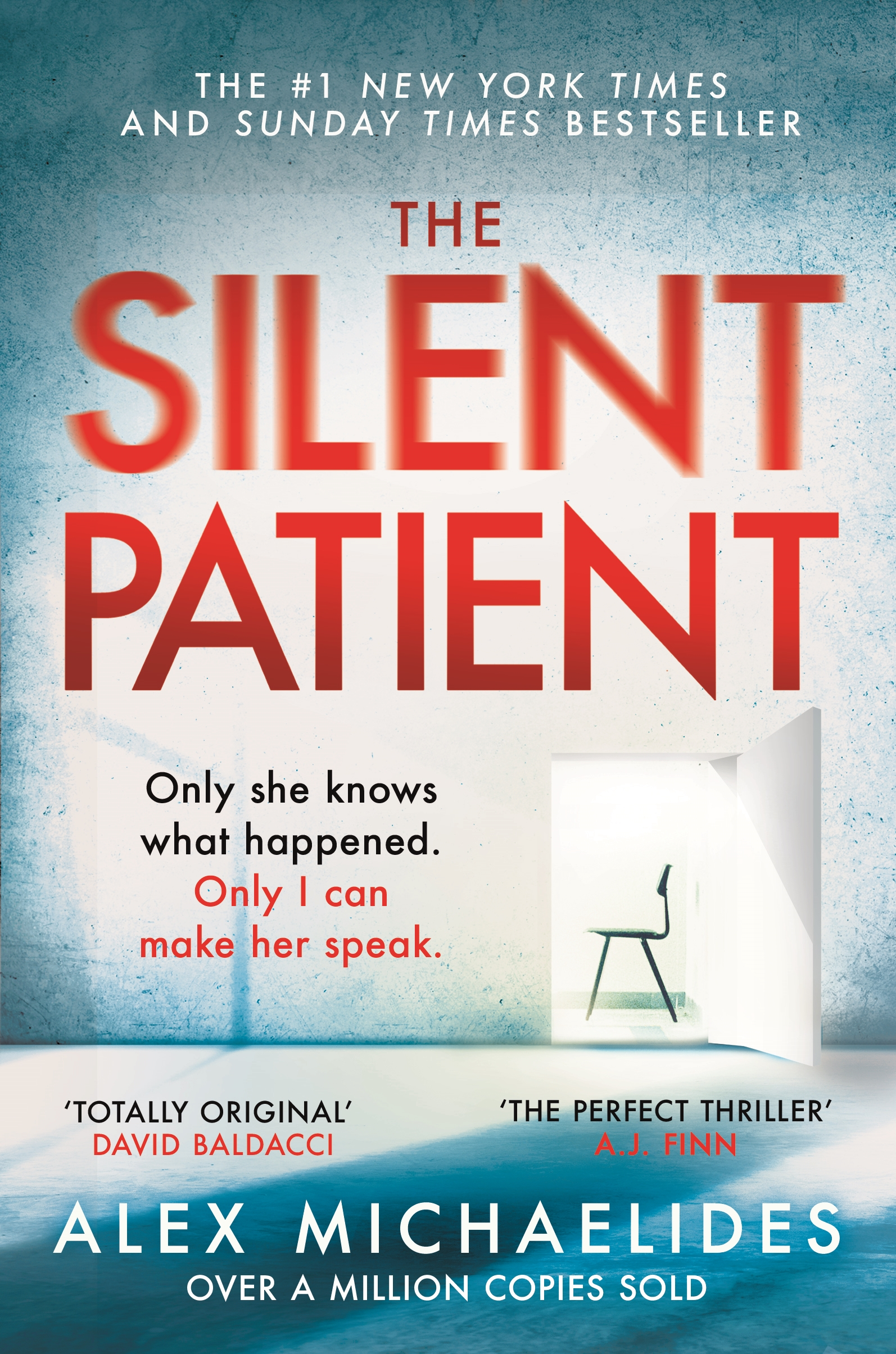
Alex Michaelidis - The Silent Patient

Only she knows what happened.
Only I can make her speak.
I love him so totally, completely, sometimes it threatens to overwhelm me.
Sometimes I think-
No. I won't write about that.
ALICIA
Alicia Berenson writes a diary as a release, an outlet - and to prove to her beloved husband that everything is fine. She can't bear the thought of worrying Gabriel, or causing him pain.
Until, late one evening, Alicia shoots Gabriel five times and then never speaks another word.
THEO
Forensic psychotherapist Theo Faber is convinced he can successfully treat Alicia, where all others have failed. Obsessed with investigating her crime, his discoveries suggest Alicia's silence goes far deeper than he first thought.
And if she speaks, would he want to hear the truth?

Comment: I've decided to give in to the hype and read this book but thankfully, two friends had not read it either and we could buddy read it, making the experience more interesting.

In this book, we have a psychological thriller about Alicia Berenson, who is accused of killing her husband but since being caught, she has not spoken a word, not even during the trial. Now, Theo Faber, a psychotherapist who is interested in her case, decides to apply for a job at the clinic where she is being treated and he believes he will be able to reach her. However, things don't go as easy as that and Theo eagerly investigates Alicia's life on his own, trying to find some clue that might point in the right direction. At the same time, he must deal with personal problems which might affect his decisions, but will he truly discover why Alicia is silent?

It is true that this is a very fluid and easy book to read. The chapters are short and objective and it helps the reader to have a very clear image of what is being said, which in turn makes the narrative feel as if it's flowing. I understand the appeal because it's easy to turn the pages and have the sensation the twist/resolution will arrive quickly.

As for the writing... well, in that I would say things aren't as smooth because while this is easy to read, I really expected more from the narrative sequence and the psychology of the characters. In that regard, just thinking to myself about other books in the genre, this wasn't as fascinating as the accolades made me believe... it's true the base of the story is quite ingenious, but the execution didn't feel as convincing as I hoped considering the hype.

The story is actually very simple: Alicia and her husband seemed in love and devoted to each other but one hot day in summer she kills him, is caught red handed, but speaks no word since then. Alicia is a painter and her last painting presents an intriguing clue, the image of an old Greek tragedy where a woman dies for her husband, is saved but never speaks again. Alicia is deemed unbalanced but she does not say a word to defend herself. Theo Faber thinks he might help her and while we follow his thought process, we can see he might have an agenda, although it doesn't seem obvious right away. He also deals with personal issues and it seems clear he will discover why Alicia won't speak but not how.

The idea of this novel is very good, yes. I especially liked the connection with the Greek tragedy and thought this would have an even stronger importance to the big picture but after all, the explanation is a bit more mundane. Still, after knowing Alicia's reasons, why she was deemed unstable, even for situations previous to the murder, I must say the connecting clues are a little flimsy. I say this because we don't get to have access to the information in such a way that makes it serious enough.

In part, I got this feeling because Theo as narrator is clearly unreliable. This was an interesting decision by the author, the focus isn't, therefore, simply on the case or in Alicia's character, but in how the therapist interacts with the surroundings. He, then, acts as if he was an investigator or as if he was some kind of authority, which immediately made me a little unsure about where the author was taking this, after all how this guy be so noisy and no one would question that?  I feel this stretched things into a path I think could have been better.

As for the things we get to learn as he investigates, some clues were definitely intriguing, namely why she painted that final painting or what she might have meant with such specific detail, but of course the goal is to know why she doesn't speak. When we do learn that, close to the end, I was a little disappointed by how weak it was. I don't think we got to have enough base before, to justify such radical behavior from Alicia. Her circumstances in the past were certainly serious, I don' mean to belittle her past experiences and how they shaped her personality, but between what we know of her life, before and after the murder, just doesn't compute in terms of seriousness. I feel we had to be led to believe many things not always consistent.

The consistency of information given throughout the story is often easily ignored because of the fluidity of the narrative, but thinking about it in a more isolated way, I think there are just too many inconsistencies, both in behavior of the characters and in why they did certain things. I think the psychological aspects weren't as developed as they could have, which might have added better tension to the novel.

When we finally are told the big twist, I wasn't truly surprised. And not because it was so easy to guess, which I suppose it might have been if one only focuses on certain details, but because I simply disappointed with how the author chose to present the climax. The connection between all elements was special yes, but since the book is told by Theo in first person, with a few diary entries by Alicia, I think the big twist was actually wasted. I think this would have gone better if the narrator had been third person. The thing is, we have to suspend disbelief once more, to accept that the explanation given is well planned. I was more meh about it, even more so after having read other books where the unreliable narrator was achieved so much better.

All things considered, this was a very easy book to read and had very good scenes and some ideas I really liked. But the overall effect wasn't very convincing for me and the shock factor wasn't as big for me because of writing options. 
Grade: 7/10