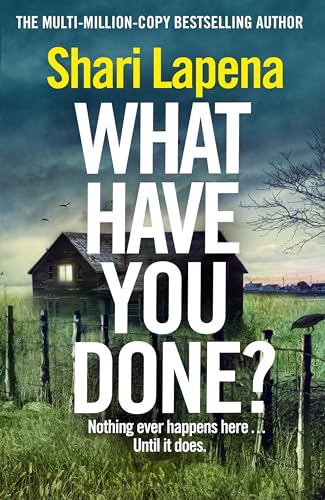
The teenagers get their kicks telling ghost stories in the old graveyard. The parents trust their kids will arrive home safe from school. Everyone knows everyone. Curtains rarely twitch. Front doors are left unlocked.
But Diana Brewer isn’t lying safely in her bed where she belongs. Instead she lies in a hayfield, circled by vultures, discovered by a local farmer.
How quickly a girl becomes a ghost. How quickly a town of friendly, familiar faces becomes a town of suspects, a place of fear and paranoia.
Someone in Fairhill did this. Everyone wants answers.
Comment: This book was a gift for my birthday last year, if I remember correctly. I had heard of the author but never felt the impulse to try, but since I was given this book, of course I'd try it.
In an apparently peaceful Vermont small town, everything is normal and is all the inhabitants expect, but one morning a farmer sees something strange in the behavior of vultures and that is how he finds the body of a teenager, naked and dead. It soon becomes obvious the girl was murdered but by whom and why? The police starts investigating and things seem to be a mystery for all, but as nerves and people's secrets start coming to life, it does seem there isn't much normalcy in the case nor in the small town as everyone assumed...
It was quite the experience to read this book. It was my first attempt with this author like I said and I must say I wasn't particularly impressed, despite founding the story easy to follow and to read. I'd say my main issue is related to the writing style, which I've found to be a little too superficial for this genre.
The plot is very straightforward: Diana, a young student in her last high school year is found dead, clearly murdered. The last person to have seen her is quickly established to have been her boyfriend Cameron but he claims he left her in her house at an hour earlier than the estimated time of death. The police tries to follow some clues, does some diligence investigation but certain factors are only taken into consideration after some characters share tips and/or tell secrets.
Well, right here is one of the reasons I wasn't too impressed... this isn't a master plan on police investigation nor is a psychological game the characters play since some breakthroughs in the case happen after characters tell things later than when they should, for this or that personal reason. This means it was very easy for the police to connect the dots without much cleverness or many steps and everything felt too much a coincidence. Of course, this feeling is given to the reader because we have several POVs and some characters just aren't layered enough to make this a compelling exercise.
With this I mean that the plot doesn't need to be complex but then the characters should be, or the other way around, more psychology/depth to the characters even with a simple plot development. The characters we should like were easy to like, the shady ones easy to dislike and the naive ones were both annoying for their lack of vision or pitiful because they could not add much to the big picture. I was not impressed with the red herrings that are presented either and actually found them to be a little careless, and the characters really were clumsily used in this plot. I would have liked it a little more if the characters' personalities had had more dimension.
While I was reading, I've gotten to the point where I wasn't really that interested in who killed Diana, but mostly in why since she really didn't seem to have a dark side or anything like it and the wrongness of some characters around her didn't seem to be influenced by her conscious behavior. I was quickly and easily going through the pages, eager to finish so I could have one more book completed, not very surprised by the supposed great discoveries but going on at a good enough pace, when the author finally comes up with the big twist.
I did not see it coming and I don't mean this in the sense that it was such a bright choice that I was left speechless. I mean it in the sense that no clue would lead to this. I think this happened because the author could not find a way for the necessary information to be in the back of our minds since it came out of nowhere, so how could anyone even assume it? Nothing about the character would suggest this possibility, so it felt like a wrong choice, and not a really twisting one. Why would that character behave like that, what kind of reasons could have led the person to do that? I was not convinced by the explanation.
No comments:
Post a Comment